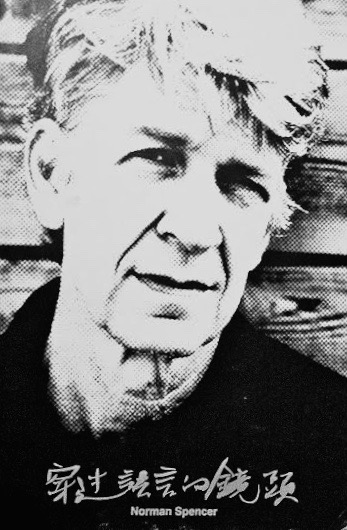
Norman A. Spencer, Ph.D. has taught at universities in Africa, China and the United States including Tianjin Foreign Cultures University in China from 1982-1983 and China Communications University in Beijing from 2001-2002. He has written on African, West Indian and African American culture and politics. He edited with Shirley Geok - Li Lim One World of Literature (Houghton Mifflin, 1993.) He edited and wrote the introduction for Yan Li’s book Things Are Symbols of Themselves (Shanghai,2006.) An interview with him about his cultural activities in China was published in BeiDao’s Jintian (Today) in Hong Kong in 2007. He published a photography memoir with commentary on Chinese independent and underground cinema in the twentieth anniversary issue of Positions: Asia Critique (Duke University Press, 2012) And his photography book I Experience the World through My Lens was published by Artron Art Group / Yachang Beijing in 2014. The University of California at San Diego is collecting his Chinese and Vietnamese contemporary culture photography in digitaland printed out formats. Professor Spencer was active in the Civil Rights Movement in the American South during the early 1960s. He attended the Highlander Folk School where the famous song“We Shall Overcome” originated. He was a member of SNCC and SDS while he was a student at Sewanee: The University of the South which was racially segregated during this period. Later he fought in the Vietnam War as a seaman in the U.S. Navy but was active in the anti-war movement when he returned to the U.S. He did a M.A. at San Francisco State University when it was a center for the Black Arts Movement and laterwrote a Ph.D dissertation under the direction Amiri Baraka/ LeRoi Jones, the radical African American writer, intellectual and political activist, at the State University of New York at Stony Brook.Professor Spencer currently lives in New York City and is a full time professor of English at State University of New York at Nassau. He is married to Peng Xiaojian (Shanghai, 1974). They have a house in a Bai (minority) village near Old Dali in Yunnan Province in the south of China where they spend their vacations and sabbatical leaves.

 二零一七年第三期